

It's Giving...Becoming
Finding a Spacious Place in a Flock and Family

A couple of weeks ago, I attended Calvin University’s Festival of Faith and Writing. I was enamored with Sarah Perry, author of the award-winning novel The Essex Serpent, and how she could say hard things in her work, yet leave people encouraged.
Bent over our copious notes, Dr. G and I discussed what we’d just learned. Dr. G said something I cannot stop thinking about.
She expressed concern that my social media message fell short of reflecting the healing that has taken place in my relationship with the church. She said, “I watched you lead worship last week and sensed how you loved being there, singing to God and leading his people. You love being part of the church now, but I’m not sure that change comes through in your storytelling about yourself.”
She wasn’t critiquing me. She was inviting me to share a deeper part of myself in the midst of speaking truth to power.
Sarah Perry was talking about writing honestly, but in a way that consoles. Not just telling the truth, but telling it in a way that lets people breathe. As I’ve mulled over Dr. G’s and Sarah Perry’s words, I realized something.
If you only knew me from my posts, you might think I love Jesus but don’t want to hang out with his people—or at best that I merely tolerate them in public but talk smack about them with friends. I talk smack about a lot of things—but that is not one of them.
So let me clarify. I see two kinds of faith communities on opposite ends of a spectrum.
One, which we’ll call “the church,” insists on gender hierarchy, lords power over people by enforcing rigid gender roles, and does not acknowledge the internalized misogyny in its practice or hermeneutics.
The other we will call “The Church,” with capital letters to acknowledge the flock of believers who exist locally and globally. This group operates like a healthy Spirit-led family. No one hoards power over anyone. As a family, they help each other see their blind spots. As a flock, they follow Jesus the Shepherd, doing the best they can to build each other up and encourage each other to grow in Christlikeness. This flock loves each other and acknowledges that together we thrive best. The Church fosters the spirit of becoming a flock and a family.
I have been hurt in a church. Deeply. Traumatized, even. But the church is also where I have been healing. It’s where I’m learning I don’t have to shrink. It’s where I’ve stopped performing for approval. It’s where I’m becoming.
Becoming…
In counseling, we started using that word—becoming—because for most of my life I thought if I could just jump through the right hoops, say the right things, and keep everyone pleased, then life would work out okay. When I became a believer in 2010, I just rolled that thought process into my faith. That meant I outsourced my agency to whoever seemed most spiritually in charge.
That system will gut you like a fish.
Becoming…what?
So I started untangling and rebuilding. I posed questions to God like:
If I don’t do another good thing on this earth, do you really delight in me?
If you are grading, is there going to be a curve, and is it an open-note test, or are you serious about me already passing?
Are you sitting there watching me, waiting to flick me on the head when I fail, or do you watch with anticipation at what your daughter will do next, delighted no matter what?
Do you want me to impress you, God, or are you just asking me to follow my inner Spirit-filled voice?
Always one for a good checklist, I had to buck up and face the facts. Life with God is not about a list or a mold to fit into. I needed better language. So in counseling, Dana helped me find becoming. And now becoming is my jam.
Becoming looks like standing up, stretching out, using what I’ve been given, and living with wonder instead of fear. Becoming means growing into a person who is certain of God’s love and certain of her worth. It means being able to recognize when something—even something dressed up as “biblical”—is trying to make you smaller, and then standing firm against it.
That’s the tension I live in.
Misogyny out. Becoming in.
I hate what misogyny has done to women in the church. I hate the way “biblical gender roles” have been used to silence, limit, and spiritually disorient women. But I love The Church, the one that desires to become a flock and family. That great theologian Taylor Swift says, “I want to be known for what I love, not what I hate.” So let me tell you what I dearly love about the flock and family I have found—even as I still hate misogyny.
I love that the pastor at the church I now attend stood in the pulpit and said plainly that abuse and subjugation of women is wrong and that it breaks God’s heart.
I love that my worship pastor prayed over me when I felt trapped in my own body, like I couldn’t even sing to God anymore because of words spoken over me by men who wanted me small. I love that when I said, “I want to feel free to sing,” he didn’t correct me—he cried with me.
I love that my church is equipping women to use their gifts, not in tiny corners of ministry where their gifts have been relegated, but for the whole church.
I love that, though we are deep in the heart of Texas, in what often feels like hierarchy-complementarian ground zero, my church exhibits gender parity every Sunday.
I love that I am part of a church that is helping me heal.
And what I want for my wounded-by-the-church sisters is to find that same kind of space. A spacious place. Not a tight, monitored life where you’re constantly adjusting yourself to fit someone else’s definition of “biblical womanhood,” but a life where you can stand up, stretch out, and see what God might do through you. I am willing to say the hard truths, but I trust it is for the woman stuck in molds that don’t fit. I love them and The Church too much to stay silent.
Hear Me Out
Take a look at this photo from 2016-ish.
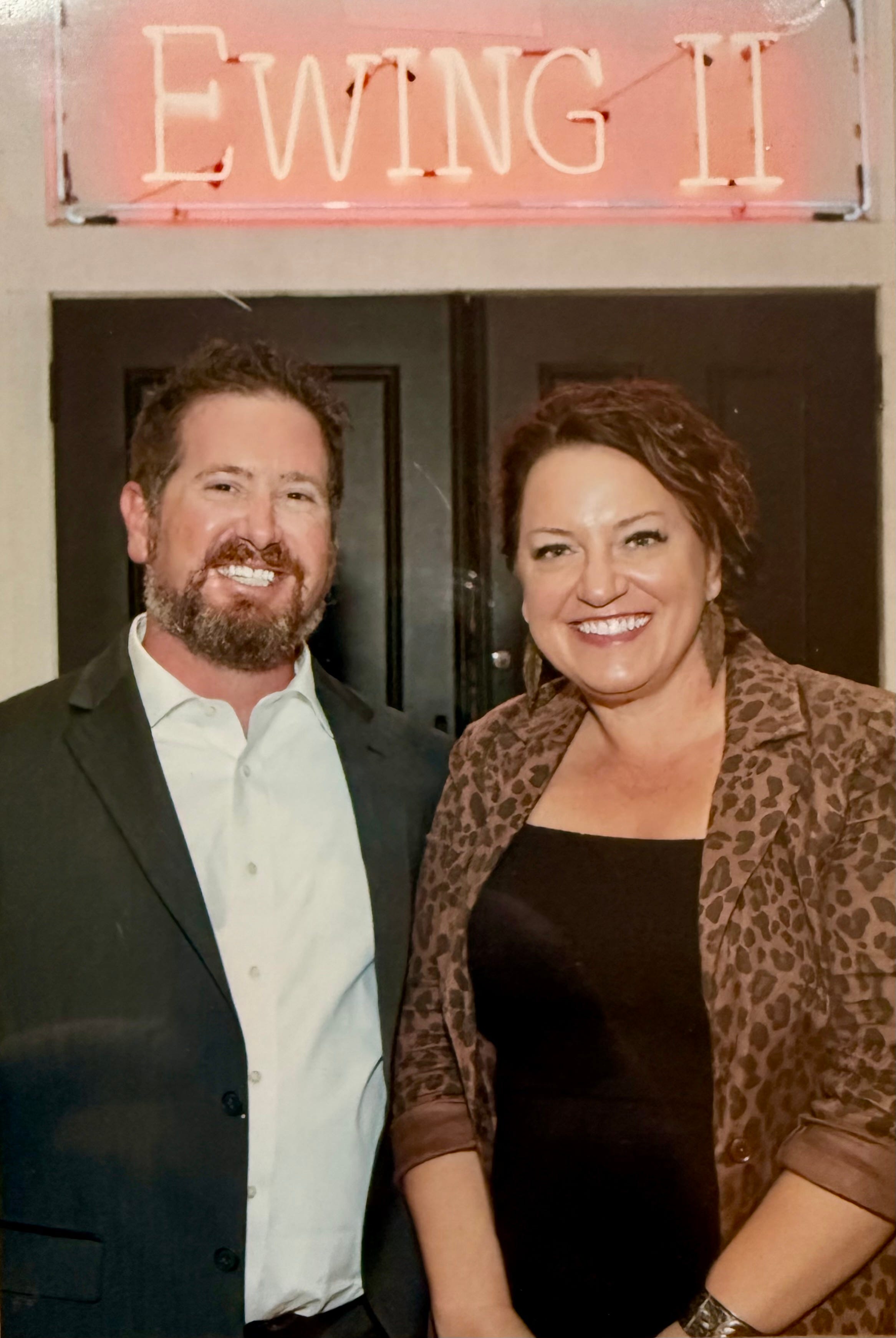
Since a picture is worth 1,000 words, my posture in this photo attempts to communicate my desire to shrink myself to fit under my man’s ‘headship’ over me, making it an excellent example of so-called biblical womanhood. A few problems. I weigh more than Jesse in this photo. In heels, like I’m wearing here, I’m taller than him. And I am doing all the work to communicate our ‘biblical’ manhood and womanhood because Jesse refuses to play along. He won’t try to be bigger than me or strike the ‘I am the head of my woman’ pose, fully secure in his manhood and not feeling the need to be bigger than me. He’s just happy to be there with me at a fancy dinner, standing in front of a Dallas-themed neon sign.
So, here’s my “hear me out” moment.
What if we just tried something different instead of asking women to shrink down? What if instead of assigning roles based on gender, we actually paid attention to how people are gifted? What if a man who is wired for service is celebrated in that calling, bringing meals and caring for people in ways that quietly hold the church together? What if a woman who is gifted to teach is equipped and released, not gatekept, and her voice becomes the thing that finally helps someone hear the gospel clearly? What if we stopped managing outcomes and started trusting Holy Spirit?
Let go of your pearls, hear me out.
Let’s say we try it for five years. Worst-case scenario, hell opens up under our churches and they burn down into a smoldering heap. We panic, assuming God has abandoned us for a more obedient universe because we let women off the chain. Totally fine. All us ‘Jezebel’ women will sit down and shut up so we can invite God back into our midst. The men can grab the fire extinguishers, reclaim the church from the ashes, and rebuild it with proper safeguards, maybe even gates around the pulpit and locks on the elder meeting space doors, perhaps with gender scanners so they only open for men.
But what if that’s not what happens? What if it changes everything?
Jesus didn’t build a hierarchy to protect. He formed a family and leads a flock. In his family, power isn’t hoarded, it’s given away. In his flock, he provides the care we need to thrive.
So yes, I speak loudly against misogyny in the church, because I have tasted what healing feels like when I am gathered with the flock and the family. Because I have experienced what it means to become.
And I want that for every woman I know. (And God does too.)