

Luke and Conjunctions Sitting in a Tree
C-O-N-N-E-C-T-ING Stories Since 60 CE

I hear the teacher say, “Class, we are going to read this section of the textbook aloud. Judy, start at the subtitle, ‘Cells: The Building Blocks of Life,’ and we’ll end at the next subtitle.
Abject panic rises in me; I try to count off and match up the classmate to the paragraph, attempting to predict which paragraph will be mine. I need to read it like the world’s best orator to avoid being made fun of for the rest of my school career.
But in my counting, I’ve lost track of where we are. And now my frienemy, Stacy Buss, who sits right in front of me, is reading aloud as if she were born to do so, with a beautiful lilt to her voice.
I think, “I’m dead in the water; I’m going to have to tell the whole class I lost my place.”
Resigned to my fate, when Stacy stops speaking, I look up and open my mouth to confess when I hear the teacher say,
“Thank you, Stacy. Sarah, you will pick up at the subtitle: ‘ Cells: The building blocks of life,’ after lunch.”
The subtitle.
That BLESSED subtitle.
It saved me.
That blessed indicator of a change in topic saved me from humiliation.
(Ugh, I am sweating just from telling that story, are you? Was anyone else subjected to that kind of horror in school?)
But those are not the kind of subtitles I want to address right now. Blessed as they may be at times, some subtitles are sneaky ways of shaping our theological imagination and interpretation of Scripture.
Also, this is the second month of me writing about Mary and Martha, and you may think,
“Good Lord, she is beating a dead horse here.”
What can I tell you? It’s the section I chose for my Greek class this summer, so I’m taking all of you along for the ride—this horse is still alive and kicking.
If we’re going to ask whether subtitles shape our interpretation, the obvious question is: Did Luke write them?
It’s All Greek To Me
The NT is written in an ancient language called Koine Greek. The authors wrote in all capital letters with no spaces. Why? Partly because writing materials were expensive and because continuous script was the normal writing convention. This means that translators became experts at reading the puzzling text. It looked like this:
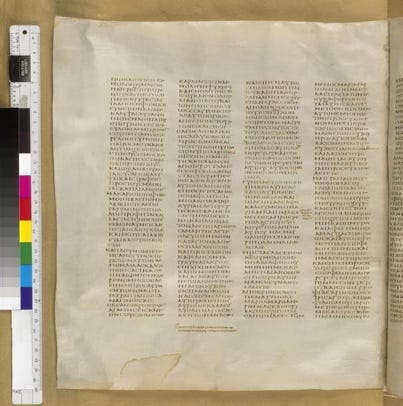
Image: Codex Sinaiticus (Luke), courtesy of the Codex Sinaiticus Project. Accessed July 26, 2026. Codexsinaticus.org
As Koine Greek became less familiar to readers and the cost of materials went down, scribes, editors, and eventually printers and translators started adding subtitles for ease of navigation. By the 13th century, we see many of the subtitles appear in manuscripts that we still use today—but Luke did not write those.
Today our Bibles have section headings, section titles, headings, and chapter summaries that all make it easier for us to navigate through the Bible. And thank God for that because it still takes me five minutes to find the book of James; imagine if we had no navigation tools.
But as English readers, we have to be aware of the power subtitles have over us. From childhood, we’ve been trained to treat them as signals that one thought has ended, and another has begun. I can’t be the only one who reached a section title in a textbook and silently congratulated myself for making it to the next subtitle. That same instinct doesn’t disappear when we open our Bibles.
The problem isn’t that subtitles exist. The problem is that sometimes they persuade us to stop reading before Luke has finished making his point.
Subtitles: They're Just Trying to Help
So, in the year of our Lord 2026, Luke 10 in the NIV looks like this:
Jesus Sends Out the Seventy-Two
10 After this the Lord appointed seventy-two others and sent them two by two ahead of him to every town and place where he was about to go…
Sarah’s summary: Luke tells the story of how Jesus says to them that the purpose of their travel is to go ahead of him and tell people that the kingdom of God is near. They should only make this announcement to the people who welcome them in, and for these people they may perform the miracles that accompany the announcement of the coming kingdom; healing the sick, casting out demons. If they find they are not welcomed, they should move on because those people are rejecting Jesus. Upon the return of the seventy-two, Jesus praises God for the way the news of the coming kingdom has moved among people who have eyes to see and ears to hear.
And the passage ends with…
Then he turned to his disciples and said privately, “Blessed are the eyes that see what you see. For I tell you that many prophets and kings wanted to see what you see but did not see it, and to hear what you hear but did not hear it.”
And then the subtitle…
The Parable of the Good Samaritan
On one occasion an expert in the law stood up to test Jesus. “Teacher,” he asked, “what must I do to inherit eternal life?”
“What is written in the Law?” he replied. “How do you read it?”
He answered, “‘Love the Lord your God with all your heart and with all your soul and with all your strength and with all your mind’; and ‘Love your neighbor as yourself.’”
“You have answered correctly,” Jesus replied. “Do this and you will live.”
But he wanted to justify himself, so he asked Jesus, “And who is my neighbor?”
In response, Jesus tells the story of the Good Samaritan.
Sarah's summary: a man is robbed, beaten, and left for dead on the side of the road. A priest and a Levite pass the man without rendering aid. A Samaritan provides aid to the man and cares for his needs so he can be healed.
And the parable ends with Jesus saying this…
“Which of these three do you think was a neighbor to the man who fell into the hands of robbers?”
The expert in the law replied, “The one who had mercy on him.”
Jesus told him, “Go and do likewise.”
And then the subtitle…
At the Home of Martha and Mary
As Jesus and his disciples were on their way, he came to a village where a woman named Martha opened her home to him.
How do we know whether the subtitles are affecting how we read this passage? I’ve got one word for you: Conjunctions.
Conjunctions: So Much Cooler than Subtitles
Since there were no visual headings to separate thoughts, Luke used grammar to show how his ideas connected.
And now that I’ve discovered these little beauties, I love them. I think conjunctions are wildly underappreciated. Most lexicons barely mention them because they’re like, “Well...yeah, of course there’s a conjunction there.”
I’m afraid we’ve hurt conjunctions’ feelings.
So, I’ve started a campaign called Connections for Conjunctions.
Conjunctions are not self-supporting, so I’ll be launching a GoFundMe soon to make sure they get the representation they deserve.
(Good grief...a grammar joke? Who even am I anymore?)
At the end of the section about the Seventy-Two going out to proclaim the kingdom of God, Luke records Jesus saying, “Blessed are the eyes that see what you see. For I tell you that many prophets and kings wanted to see what you see but did not see it, and to hear what you hear but did not hear it.”
Then Luke introduces the next character with a conjunction. He uses Καὶ ἰδοὺ—literally, “And behold!”
What if Luke is showing us, “And behold! One who wants to hear but does not and wants to see but does not. Because the expert in the law comes to test Jesus, not celebrate him. I think the subtitle, The Parable of the Good Samaritan, causes us to lose the connection between the story of the seventy-two and the illustration of one who is rejecting Jesus.
After the subtitle At the Home of Mary and Martha, there is a Greek conjunction, δέ. It functions as a logical conjunction that can join ideas or mark a new development. It’s usually translated as “and now” or “then.”
And so, if we fight to hold Luke’s train of thought, despite the subtitle, and with a more literal rendering of the Greek conjunction, we would read: “Then Jesus told him, ‘Go and do likewise.’ And then Jesus and his disciples were traveling, and they came to a village where a woman named Martha opened her home to him.”
Jesus himself became a traveler. As seen in the parable Jesus has just told, anytime anyone traveled, they faced the threat of violence. But Jesus did not meet violence on the road because the woman Martha welcomed them when they reached her village. Martha took “Go and do likewise” to heart.
Instead of a woman flipping out about making dinner and hosting a group of people, Luke presents Martha as an example of, “‘Love the Lord your God with all your heart and with all your soul and with all your strength and with all your mind;’ and, ‘Love your neighbor as yourself.’” If Luke intended Martha’s action to be merely a lesson about dinner, why use a conjunction before her story? Why not use, “Ugh, check out this chick Jesus met when traveling…” I’m just asking.
Don’t Think Misogyneutics Missed Out on the Action
My issue isn’t with subtitles. My desire is to follow Luke’s train of thought, fighting my brain, which has been trained from childhood to treat subtitles as markers that one thought has ended, and another has begun.
Luke had conjunctions available to him that could have clearly signaled the end of one story and the beginning of another. He could have used an inferential conjunction to conclude his point (”therefore...”), or a temporal marker to indicate a new scene (”after these things...”). But he doesn’t. Instead, he connects these short narratives together, and I think that means he intended one to inform the next.
I think disregarding Luke’s use of conjunctions causes us to lose the literary structure of his argument: story, example, story, example. Jesus teaches. Luke illustrates. Jesus teaches again. Luke illustrates again.
When we isolate the Mary and Martha account from what comes before it, it becomes much easier to read it primarily as a lesson about Martha’s domestic shortcomings. The flow of the chapter begins to look something like this:
The seventy-two go out on mission.
Jesus tells the story of the Good Samaritan.
Then we have what appears to be a side story about a woman who complains that she has to host Jesus and feed a crowd.
But if Luke intended us to keep reading through the conjunctions instead of stopping at the subtitle, another possibility emerges. Martha is no longer a rabbit trail about women’s work. She becomes Luke’s first illustration of someone doing exactly what Jesus has just commanded: “Go and do likewise.”
This is exactly the kind of interpretive move I call misogyneutics. It isn’t changing the Greek text. It isn’t even a mistranslation of a word. It happens when editorial decisions, translation choices, and interpretive assumptions quietly reshape the picture we form in our minds until a story about discipleship for everyone becomes a story primarily about correcting a woman’s domestic attitude.
I’m not suggesting subtitles are bad. I’m suggesting they deserve the same careful evaluation we give every other interpretive aid. If Luke’s conjunctions invite us to keep reading, then perhaps we should resist letting a bold heading interrupt an argument that Luke himself never stopped making.
What do you think? Are you team subtitle or team conjunction?
“Conjunction Junction, what’s your function?” 🎶 I am here to applaud the grammar jokes and express my admiration for your insight into how grammar matters in good interpretation. Keep going👏🏼👏🏼👏🏼