

Theological Imagination
What Is It, Why Do I Need It, and Where Do I Get It?

Our imagination is engaged anytime we read narrative. Your brain imagines what the setting and characters look like and what their voices sound like. You imagine what you might do or how you might feel in a character’s position. This is part of the power of narrative: because so much of your mind is involved, the story stays with you. You get lost in the plotline, identify with characters, and lift out the underlying truths the author wanted us to find.
Much of the Bible comes to us through narrative, and Scripture as a whole tells a story with the supernatural power to change us. Much like a book engages and develops your imagination, the Bible engages and develops your theological imagination. I think this is exactly how God intended it. Under the tutelage of the Holy Spirit, our interaction with Scripture grows our understanding of who God is and who we are in light of Him.
But we are thousands of years removed from the original authors, languages, cultures, and audiences. Careful work is required to understand the text as closely as possible to how its authors intended it to be understood.
Translation and interpretation are undertaken by people who have spent their lives engaging in this work. Our modern translations are trustworthy because scholars work diligently to communicate the original text as faithfully as possible. The Bible you hold in your hand can be trusted.
Interpretation, however, is not the same as translation.
Hermeneutics—the study of how we interpret Scripture—asks us to engage with Scripture on its terms, allowing the original authors to say what they wanted to say in the way they wanted to say it. Interpretation takes the text and asks: What is the authorial intent? What was the intended effect on the original readers? And what should we, two thousand years removed, do with it?
It is the difference between asking, “What did Paul say?” and asking, “Why did Paul say that?”
Well-rounded hermeneutics helps prevent us from making Scripture say something it doesn’t intend to say. It also asks us to acknowledge that we all come to the text with biases, assumptions, and gaps in our understanding.
And this is where things get complicated.
Because narrative engages our imagination, sometimes our preconceived notions fill in what the text leaves unsaid. We assign motives. We hear tone. We decide who the hero is and who the problem is. Sometimes we don’t even realize we’re doing it.
God can handle that. He is the one who chose to communicate so much truth through story.
Scholars work hard to account for these limitations—seeking multiple points of view, noting disagreements over translation and interpretation, and acknowledging places where judgment is required. The goal is to allow the text, as much as possible, to shape our theological imagination rather than allowing our theological imagination to reshape the text.
However…
…what happens when the imagination we bring to Scripture has already been shaped by misogyny?
This is the question at the center of much of my work.
I believe our theological imagination has been shaped in such a way that gender hierarchy—the dynamic where men lead and women submit—can seem as though it is God’s ideal.
I am one who has seen and experienced it.
And because I prefer a life where everyone is mad at me all the time, I have chosen to advocate against misogyny in the interpretation of Scripture and call us to reconsider interpretations that undermine the shared commission God gives women and men in Genesis: together, bearing God’s image and exercising dominion over creation.
To help identify what I see as wrong with this approach to Scripture, I’ve coined “misogyneutics.” This is where misogyny and hermeneutics collide. When employed, the interpretation subjugates women and forces us into a gender hierarchy that I do not believe is God’s ideal for humanity.
I believe misogyneutics uses tactics that shape our theological imagination in ways that bolster gender hierarchy and control over women. Not every man who interprets Scripture engages in misogyneutics, which is why I call it misogyneutics and not dudeneutics. Internalized misogyny, outright hostility toward women, and a desire to be in control can all lead to misogyneutics.
And so, one who constantly points out what is wrong is then obligated to offer a solution that corrects the problem and brings fruitfulness to the body of believers.
What I offer is an invitation to join me as we attempt to reshape our theological imagination with a corrective hermeneutic.
For many of us, our theological imagination has been skewed to see Scripture in a way that suits misogynists. What we need is to notice the ways and tactics employed to shape our imagination, hold those before God, and ask, “How did you intend me to imagine this?” Then, through the power of the Holy Spirit, we stay steadfast or adjust our alignment so we are in step with God.
Reconsider: Notice + Consider + Align.
And you may ask, “Gosh, Sarah, this seems like a fool’s errand. How ever will we start?”
And I would say, “Gosh, I am so glad you asked. I have a plan.”
Dr. Sandra L. Glahn to the Rescue
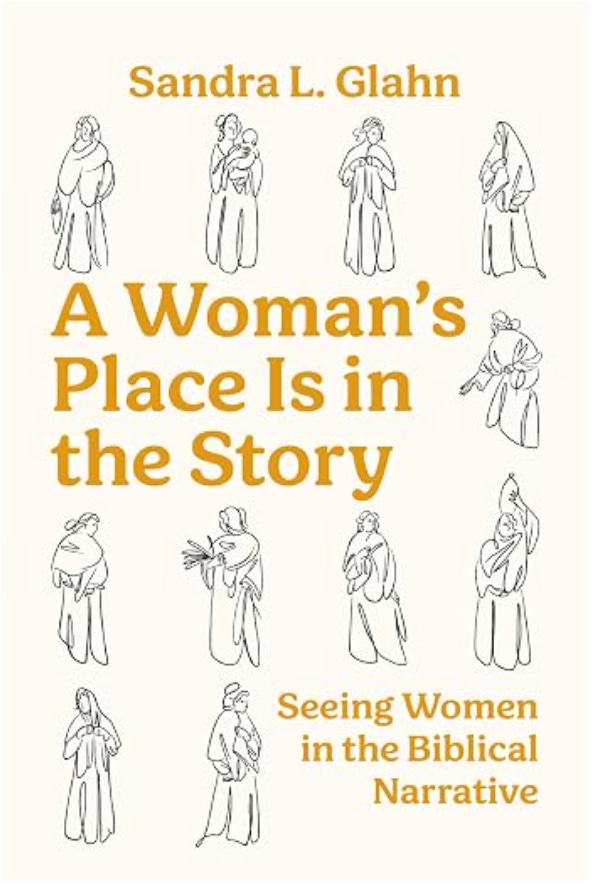
Her new book, A Woman’s Place Is in the Story: Seeing Women in the Biblical Narrative, coming out on August 25, is where we are going to start noticing where our theological imagination is skewed. Through careful and thorough research, she shows us how women’s stories have been shaped in ways that diminish their roles, besmirch their character, or use them as warnings to women that they better shape up or ship out with that Jezebel spirit.
Dr. Glahn begins by reminding us what narrative is. In the chapters that follow, she shows how reading women in the biblical narrative with a hermeneutic that rightly considers how narrative works can restore to the plot the vibrancy these women were intended to have.
She walks us through the stories of Tamar; Shiphrah and Puah; the woman who saved Moses; Abigail; the five named daughters; the woman of Shunem and Job’s daughters; Jezebel; and the woman of Samaria at the well before leaving us with a vision for moving forward.
She is the one who taught me that if you are going to point out a problem, you should also offer a solution, so it seems fitting that she models what she asks of others.
Now, I need to confess something to you.
This book is dedicated to me.
And I am not ashamed to say that this is the greatest gift that has ever been bestowed on me. When you see, “For Sarah G., Zealous Promoter of Good…” that is me. I’m that Sarah, and I’ll be happy to sign your book for you.
I’m kidding. Obviously this book is a product of Dr. G’s hard work, and I know that…
Mostly.
I bring that up, not only as a humble brag, but to fully disclose my bias. But honestly, I want to tell you, and not just because it is dedicated to me, Dr. G’s book is the greatest book you will ever read, next to her other greatest book, Nobody’s Mother: Artemis of the Ephesians in Antiquity and the New Testament. (These titles are two of hundreds of other titles she has written—all equally the greatest books you will ever read.)
But I also bring it up to tell you that if Dr. G had not shown me that my theological imagination was skewed to support gender hierarchy, I would not have stepped into the gift of being a Zealous Promoter.
Like the Woman of Samaria, who spoke to Jesus and then took off running to tell everyone about Him, I’m a Zealous Promoter. When I learn something, discover something, or meet someone whose work has brought me closer to Jesus, I run through my town—literally and metaphorically—telling everyone about it. I want you all to know about anything that has helped me move toward a better understanding of God.
But that Zealous Promoter got squashed when her theological imagination was shaped to see the woman at the well as a pitiful, loose woman who’d been found out by Jesus and, in her thankfulness that Jesus deigned to speak to her, ran through town telling everyone that he knew about all her relationships.
She was not held up like a hero or an example of open honesty. She was displayed as a hot mess running around like a crazy woman. And that interpretation shaped my imagination to see her actions as distasteful, not honorable, and I changed my behavior to match.
I’d like to journey through Dr. G’s book together; it will help us reconsider these stories and reshape our theological imagination so we can see what place these women actually hold in the story.
So, by way of a heads-up—and holding this loosely enough that I don’t overpromise and underdeliver—many of the upcoming posts will follow along with this book.
Dr. G’s book will be our guide as we notice what we’ve been taught to imagine, consider what the text actually gives us, and stay open to where the Holy Spirit may ask us to realign. Order your copy now so you get it on August 25th!
Let’s reconsider together.
I knew it was you the moment I saw the page:)
This is excellent! Looking forward to the book